John L. Pollock
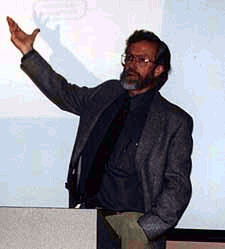

Professor of Philosophy and Cognitive Science at the University
of Arizona.
B.A. physics, philosophy, mathematics, University of Minnesota.
PhD. philosophy, University of California, Berkeley.
Mountain biker extraordinaire. Follow
this link to information about mountain biking in Southern Arizona.
The OSCAR Project
John Pollock directs the OSCAR Project, funded in part
by the National Science Foundation. The goal of the OSCAR Project is the formulation
of a general theory of rationality and its implementation in an artificial
rational agent. The project is predicated on the view that philosophy has
an essential role to play in artificial intelligence. The function of artificial
agents is to draw conclusions and make decisions on the basis of information
supplied to them. But we do not want them to draw just any old conclusions
or make just any old decisions. We want them to draw rational conclusions
and make rational decisions. We can make a limited amount of progress
in the task of building such an agent by relying upon our untutored intuitions
about what is rational. But to build a general purpose rational agent, we
need a general account of how the agent is to behave -- a theory of rationality.
The construction and implementation of such a theory is the objective of the
OSCAR Project.
OSCAR is a fully implemented architecture for rational agents,
based upon a general purpose defeasible reasoner. The defeasible reasoner
is the world's first such reasoner capable of operating in a rich logical
environment like first-order logic in which logical consistency is not decidable.
The theory underlying OSCAR is described in Cognitive Carpentry (Bradford/MIT
Press, 1995). Click here for an overview
of OSCAR, along with links allowing the current version of OSCAR to be
downloaded, along with The OSCAR Manual. The latter details the construction
of OSCAR, and explains its application to particular reasoning problems.

John Pollock is associated with the University of Arizona's
program
in Artificial Intelligence. Artificial intelligence is treated as an interdisciplinary
subject at the University of Arizona. AI research is carried out in nine different
departments, and most of these departments offer AI-related courses. These courses
collectively cover almost all of the subfields of AI, including artificial agents,
automated deduction, expert systems, game theory, language processing, machine
learning, machine vision, neural nets, nonmonotonic logic, planning, and robotics.
The associated departments include Computer Science, Communication, Electrical
and Computer Engineering, Library Science, Linguistics, Management Information
Systems, Philosophy, Psychology, and Systems and Industrial Engineering.
Fall 2001, teaching Phil202,
Introduction to Symbolic Logic.
Spring 2002, teaching Phil
455/555, Philosophy and Artificial Intelligence. The course is a general
introduction to AI, designed around the project of constructing a rational agent.
Areas of Interest
- Artificial Intelligence
- Defeasible Reasoning
- Automated Reasoning and Automated Deduction
- Planning -- both classical and decision-theoretic
- Plan Execution
- Probability
- Epistemology
- Probability
- Practical Reasoning
- Philosophical Logic
Contact Information
- Office:
- Social Science 127
- Phone Number:
- (520) 621-3120 (Office)
- Postal address:
- Department of Philosophy
PO Box 210027
University of Arizona
Tucson, AZ 85721
USA
[email protected]